
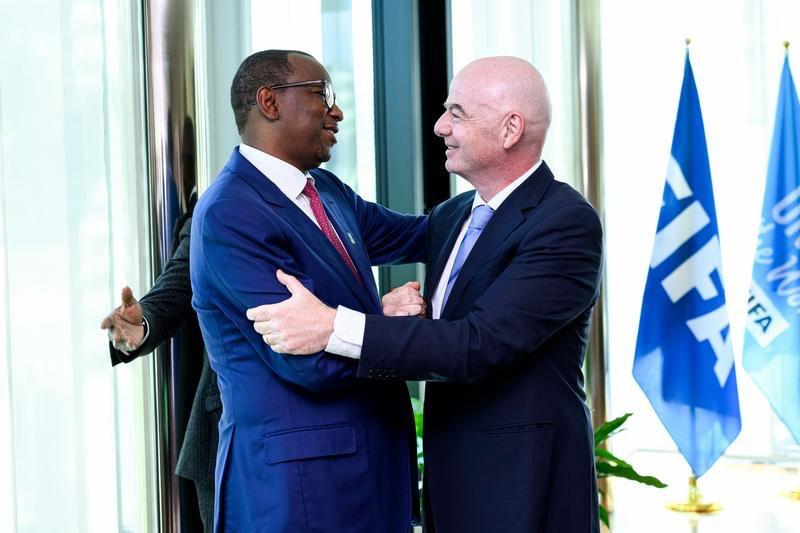
"Let's build stronger structures for Nigerian football" - FIFA President Infantino tells Dikko-led delegation
FIFA President Gianni Infantino has thrown the weight of world football’s governing body behind Nigeria’s ongoing efforts to reform and reposition its football administration, following a high-level meeting with a Nigerian delegation in Zurich, Switzerland.
Infantino received the delegation, led by National Sports Commission (NSC) Chairman Shehu Dikko, at the FIFA House on Tuesday, where both sides held extensive discussions on the future direction of Nigerian football.
The meeting came just days after the resignation of Nigeria Football Federation (NFF) President Ibrahim Musa Gusau, General Secretary Mohammed Sanusi and members of the NFF Executive Committee, plunging the federation into a major administrative transition. The NFF subsequently suspended preparations for its September 27 elective congress pending a comprehensive reform process. 
Infantino, in a message on his official Instagram account accompanying photographs of the meeting, said the discussions were aimed at aligning FIFA and Nigeria on a common vision for the development of football in the country.
“I was pleased to sit down with a delegation from Nigeria, led by National Sports Commission (NSC) Chairman Shehu Dikko, at the Home of FIFA in Zürich to hold important discussions and align on our vision for football in the country.”
According to the FIFA president, the meeting covered institutional, governance and developmental issues, as well as existing areas of collaboration between FIFA and Nigeria.
“We had a detailed talk on institutional, governance and developmental topics, as well as our ongoing collaborations,” Infantino said.
He added that the discussions also focused on the need to build stronger structures and pathways capable of creating greater opportunities for Nigerian youths, while exploring areas where FIFA could provide further support for the growth of the game.
The Zurich meeting is significant because it effectively places FIFA at the centre of discussions over the next phase of Nigerian football administration.
The NFF confirmed after the meeting that FIFA had accepted the resignations of the federation’s former principal officers and Executive Committee members and agreed to continue engagements with the Nigerian government, the NFF administration and the Confederation of African Football (CAF) towards a new roadmap for comprehensive reforms. 
The NFF said the meeting was attended by FIFA and CAF officials, CAF advisers, representatives of the NSC and the interim NFF administration, with the parties agreeing to fine-tune a roadmap covering short-, medium- and long-term reforms.
The stated objective is to ultimately produce an inclusive new NFF administration operating within a peaceful and stable environment and capable of delivering improved results both on and off the pitch. 
The Nigerian delegation included NSC Director-General Bukola Olopade, Acting NFF General Secretary Emmanuel Ikpeme and NFF Director of Legal Services Okey Obi. Former NFF President and former FIFA Council member Amaju Pinnick was also present, while CAF officials and FIFA’s Africa member-association leadership participated in the discussions.
The development comes against the backdrop of mounting calls for fundamental changes to Nigerian football governance following a series of disappointing performances by the country’s national teams.
The Super Eagles failed to qualify for the 2026 FIFA World Cup, while the Super Falcons subsequently missed out on the 2027 FIFA Women’s World Cup for the first time in the history of the competition. The setbacks intensified calls for institutional and technical reforms across Nigerian football.
Gusau, in announcing his resignation, said his decision was intended to give way to “a comprehensive and orderly reform process” aimed at addressing institutional, governance and developmental challenges confronting Nigerian football. 
The NFF subsequently appointed Emmanuel Ikpeme to oversee its Secretariat as interim General Secretary, while Ademola Olajire was named interim Deputy General Secretary. All processes relating to the suspended NFF elective congress were also put on hold. 
The FIFA engagement has also helped to calm speculation that Nigeria could immediately face sanctions over the leadership crisis.
The NFF on Tuesday dismissed as fake a purported FIFA letter circulating in the media which allegedly sought explanations over the circumstances surrounding the mass resignations and suggested possible sanctions. The federation insisted that FIFA had already accepted the resignations. 
Infantino’s public acknowledgement of the meeting and his emphasis on collaboration have consequently provided an important signal that the immediate approach is dialogue and structured reform rather than confrontation.
The FIFA president also used the opportunity to wish Nigeria’s junior women’s national teams success at their upcoming global competitions, specifically the Falconets at the FIFA U-20 Women’s World Cup and the Flamingos at the FIFA U-17 Women’s World Cup.
He thanked the Nigerian delegation for its “time, ideas and positive intent” to work together in taking Nigerian football forward.
The outcome of the Zurich meeting could therefore have far-reaching implications for the future of Nigerian football, particularly the structure of the transition, the scope of the proposed reforms and the eventual process for electing a new NFF Executive Committee.
More importantly, the engagement establishes that the next stage of Nigeria’s football restructuring is expected to be undertaken in consultation with FIFA and CAF rather than solely by domestic authorities.
With FIFA now publicly expressing its willingness to support Nigeria’s development agenda, attention will turn to the proposed reform roadmap and how it addresses the critical questions of governance, electoral processes, grassroots development, domestic competitions, national teams and the relationship between the government and the NFF.
For Nigerian football, the Zurich meeting may ultimately prove to be the beginning of a new chapter, one in which institutional reform, FIFA engagement and the creation of an inclusive new NFF leadership become the foundations for rebuilding the country’s football system.
Join the Savid News channel on WhatsApp:


