
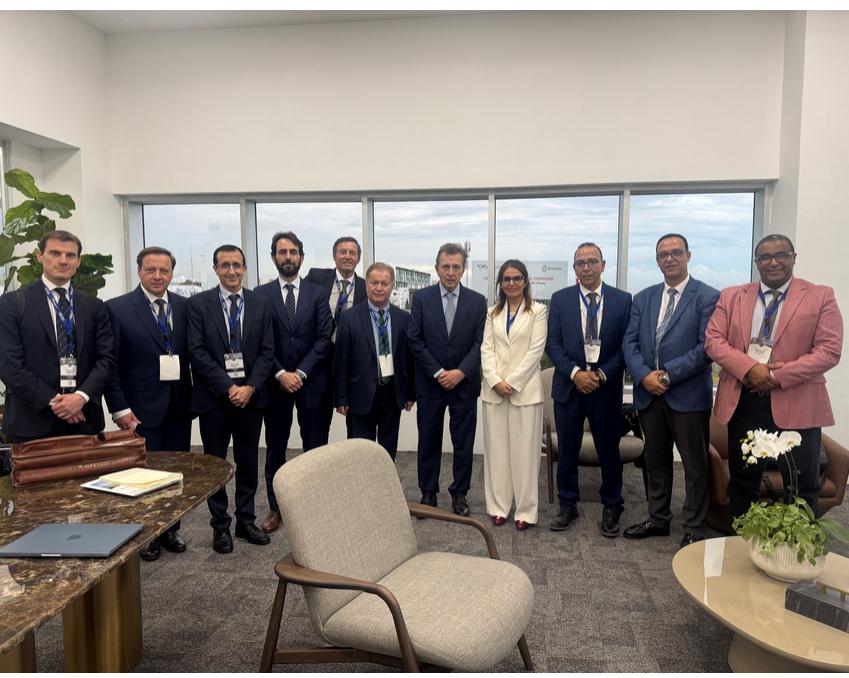
Morocco Highlights Legal Model and autonomy plan at 2025 World Law Congress
Moroccan legal experts actively participated in the 29th edition of the World Law Congress, held from May 4 to 6, 2025, in Santo Domingo, Dominican Republic. This global event, organized by the World Jurist Association (WJA) and the World Law Foundation (WLF), brought together over 300 speakers from 70 countries under the theme: "New Generations and the Rule of Law: Shaping the Future."
The opening ceremony, hosted by the Autonomous University of Santo Domingo, was attended by Dominican Vice President Raquel Peña. She emphasized the role of youth and technology in expanding access to justice. Javier Cremades, president of the WJA, warned of the threats facing global democracy, while Iván Duque, former Colombian president, praised the Dominican example of constitutional reform and denounced the increasing politicization of justice. Several prominent legal figures also participated in the opening, including Pablo Ulloa (Ombudsman of the Dominican Republic), José Alejandro Aybar (Chancellor of UNICARIBE), and Napoleón Estévez Lavandier (President of the Constitutional Court).
The Moroccan delegation consisted of four renowned jurists: Ms. Zaina Chahim, lawyer and President of the Finance and Economic Development Commission; Zakaria Abouddahab, professor of international relations at Mohammed V University in Rabat; Abdelaziz Laaroussi, professor of public law and vice-dean at the same university; and Hamid Aboulass, professor of constitutional law at the Faculty of Law of Abdelmalek Essaadi University in Tangier.
These speakers highlighted Morocco's progress in human rights, advanced regionalization, and territorial governance, particularly in the Southern Provinces. Zaina Chahim participated in a panel dedicated to human dignity, where she discussed the link between inclusive development and territorial integrity, illustrating her points with the New Development Model for the Southern Provinces launched in 2015. She emphasized the involvement of Sahrawi women in national and local institutions, as well as their role in promoting human rights through the regional commissions of the CNDH in Laâyoune and Dakhla.
Zakaria Abouddahab, for his part, addressed constitutional transitions in Arab countries. He recalled that the Moroccan Autonomy Plan, presented to the United Nations in 2007, is a response consistent with international law, particularly by drawing on the principles of the UN Charter and the International Court of Justice. He stressed that this initiative reflects a form of internal self-determination based on democratic participation and local governance.
Hamid Aboulass focused his intervention on advanced regionalization, defining it as a pillar of territorial democracy in Morocco. He highlighted the gradual transfer of powers to local authorities, direct electoral participation, and mechanisms of democratic oversight. He also presented the Autonomy Plan as an extension of this model in a specific geopolitical context.
Finally, Abdelaziz Laaroussi spoke on the theme of human dignity in times of democratic threats. He presented the African approach to dignity, grounded in community values, and illustrated the Moroccan experience through post-2011 legal reforms and public policies implemented in the Southern Provinces. He emphasized the work of the CNDH's regional commissions and integrated social policies that concretely guarantee the right to dignity.
The congress concluded on May 6 with a ceremony presided over by Dominican President Luis Abinader and King Felipe VI of Spain. On this occasion, the 2025 World Prize for Peace and Liberty was awarded to U.S. Supreme Court Justice Sonia Sotomayor.
Through their notable participation, the Moroccan jurists not only promoted the Kingdom's vision for human rights and territorial development but also reaffirmed the relevance of the Moroccan Autonomy Plan as a realistic, sustainable, and internationally compliant solution to the artificial dispute over the Moroccan Sahara.


