
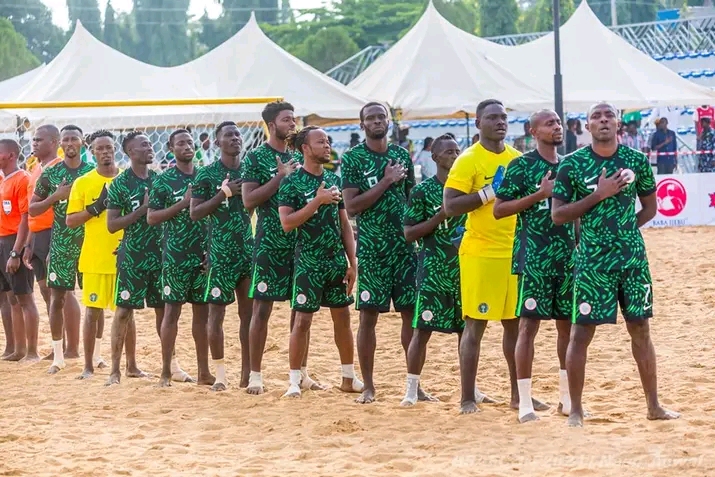
NFF Normalisation Committee: The Reform Agenda, Implemention Roadmap and why professionals matter PART 1
The current crisis in the Nigeria Football Federation (NFF) presents Nigerian football with a difficult challenge, but also a rare opportunity to undertake reforms that go beyond replacing one set of officials with another.
Following the widely reported mass resignation of the NFF President Ibrahim Musa Gusau and members of the Executive Committee, attention has shifted towards the possibility of a Normalisation Committee to oversee the federation and prepare the ground for a return to an elected administration.
The NFF has confirmed that FIFA has accepted the resignations of the former principal officers and Executive Committee members and that engagement is ongoing with FIFA on what it described as the “holistic reforms of Nigeria Football,” including the institution of a Normalisation Committee.
The development has consequently moved the conversation beyond the question of who should occupy the NFF presidency. The more fundamental question is, What should a Normalisation Committee actually do, and how can it leave Nigerian football stronger than it found it?
A successful intervention must therefore be built around a clearly defined reform agenda, implementation mechanism, professional expertise, measurable targets and an exit strategy.
1. STABILISING THE NFF: FIRST THINGS FIRST
The first responsibility of any Normalisation Committee should be to stabilise the federation.
Normalisation should not begin with politics, appointments or elections. It should begin with establishing whether the NFF’s administrative machinery is still functioning effectively.
The committee would need to undertake an immediate assessment of the federation’s financial position, contracts, sponsorship agreements, competitions, national-team programmes, staff structure, international obligations and pending legal matters.
This is particularly important because a leadership crisis at the political level does not necessarily mean that the entire administrative structure of the NFF has collapsed.
The professional staff of the federation must continue to process international correspondence, organise competitions, register players, manage national teams, communicate with FIFA and CAF and fulfil contractual obligations.
The first 30 days should therefore be devoted largely to institutional continuity and risk assessment.
The committee should produce an internal status report covering:
• NFF bank accounts and financial commitments;
• outstanding debts and liabilities;
• sponsorship and commercial contracts;
• national-team obligations;
• domestic competitions;
• FIFA and CAF competitions;
• employee contracts;
• legal cases;
• player registration;
• facilities and assets; and
• outstanding obligations to clubs, State FAs and other stakeholders.
This should not be a witch-hunt.
It should be a baseline audit from which the reform programme can be measured.
1. GOVERNANCE AUDIT: FINDING OUT WHY THE SYSTEM KEEPS FAILING
The next major assignment should be a comprehensive governance audit.
A governance audit is essentially an examination of how an organisation is structured, how decisions are made, who exercises authority, how money is controlled and how officials are held accountable.
Nigeria has experienced several football leadership crises over the years. A reform committee should therefore resist the temptation to treat the present situation as an isolated event.
It should ask fundamental questions:
Why do disputes repeatedly emerge around NFF elections?
Are the existing checks and balances sufficient?
Are the responsibilities of the Congress, Executive Committee and Secretariat clearly separated?
Are there adequate conflict-of-interest rules?
Are financial decisions sufficiently transparent?
Are disciplinary and electoral disputes resolved quickly enough?
Are State Football Associations adequately governed?
The answers should be documented in a formal Nigerian Football Governance Report.
The report should identify weaknesses and recommend specific statutory, administrative and operational solutions.
The purpose should not be to punish the previous administration but to ensure that the next administration inherits a better institution.
1. ELECTORAL REFORM: FIX THE PROCESS, NOT JUST THE OUTCOME
Perhaps the most politically sensitive area will be electoral reform.
Nigeria’s football elections have frequently generated intense disputes over delegates, eligibility, electoral committees, nomination procedures and interpretation of statutes.
A Normalisation Committee should therefore conduct a complete review of the NFF electoral system before a new election is conducted.
This should cover:
Delegate accreditation
The process for determining who is eligible to vote must be transparent, predictable and subject to independent verification.
Electoral Committee
The body responsible for conducting the election must enjoy sufficient independence and credibility.
Its members should have no obvious conflict of interest involving candidates.
Candidate eligibility
The requirements for contesting NFF positions should be clear before the electoral process begins.
No candidate should discover a new interpretation of eligibility rules in the middle of an election.
Campaign financing
There should be transparency around campaign funding, expenditure and possible inducements.
Dispute resolution
Electoral disputes should have clearly defined timelines so that disagreements do not paralyse the federation for months or years.
Election technology
Where appropriate, technology could be introduced to improve delegate accreditation, documentation, result collation and record keeping.
The objective should be a system where losing candidates may disagree with the result but cannot reasonably question the integrity of the process.
To be continued in Part 2
Join the Savid News channel on WhatsApp:


