
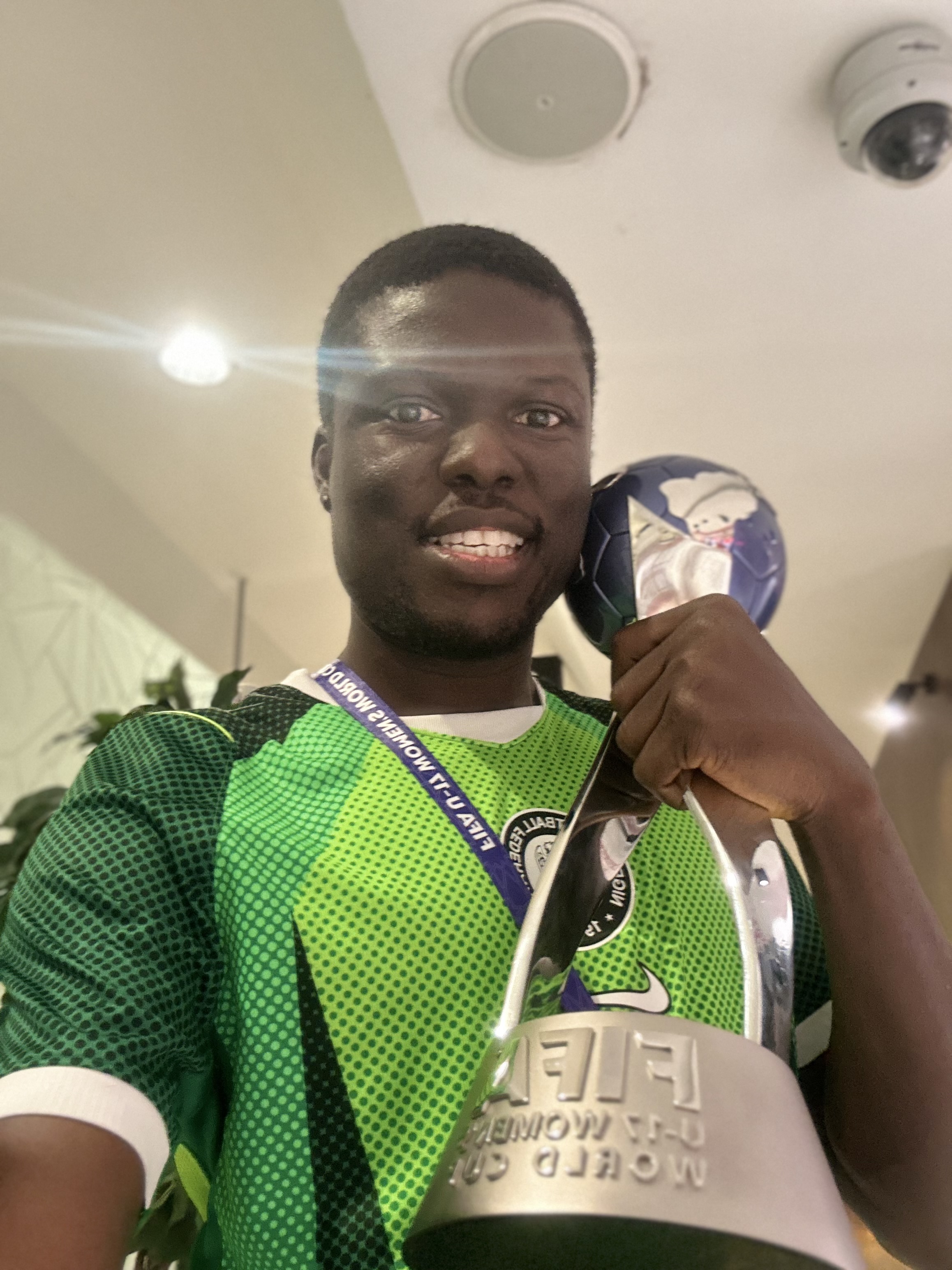
23 Days, One Dream, One History: Samuel Ahmadu’s front-row and unforgettable Morocco 2026 experience with Nigeria’s World Champions
By Samuel Ahmadu
From arriving in Morocco on October 16 to departing alongside Nigeria’s world champion Flamingos, Samuel Ahmadu recounts 23 unforgettable days covering a historic generation of young footballers, celebrating Moroccan hospitality and reflecting on the responsibility of protecting Nigeria’s emerging women’s football talents.
I arrived in Morocco on October 16, 2026, as a journalist with a responsibility to tell the story of Nigeria’s Flamingos. I departed as the only accredited Nigerian journalist who stayed with the team until the end of their historic FIFA U-17 Women’s World Cup campaign, travelling home with a group of world champions. Between those two moments lies a remarkable story of football, determination, sacrifice, journalism, friendship, hospitality and an experience I will cherish for the rest of my life.
There are moments in a journalist’s career when the significance of an assignment becomes much bigger than the stories one is expected to write, the photographs one is required to capture or the interviews one must conduct.
Sometimes, an assignment becomes an experience that defines a chapter of one’s professional journey.
For me, the 2026 FIFA U-17 Women’s World Cup in Morocco was one of those defining moments.
It was an opportunity to witness young Nigerian footballers challenge established football nations, overcome disappointment, demonstrate extraordinary character and ultimately conquer the world.
It was also an opportunity to experience Morocco once again, meet people from different cultures, engage with international football journalists, explore new places and appreciate the enormous privilege of being a sports journalist whose profession continues to take him across borders.
But, above everything else, it was about the Flamingos.
Those young girls who arrived in Morocco carrying Nigeria’s hopes and returned as world champions.
I arrived in Morocco on October 16, prepared for the demands of another international football assignment. I eventually departed alongside the victorious Flamingos, having remained the only accredited Nigerian journalist with the team throughout their historic campaign.
Looking back, I realise that I did not simply cover a World Cup.
I lived through a story that will remain an important part of my football journalism journey.
Another Moroccan adventure, another opportunity to tell Africa’s story
Morocco was not entirely new to me.
It was my second visit to the North African country in 2026, and another opportunity to appreciate its growing importance as a destination for international football competitions.
My earlier assignment had already given me an opportunity to experience the country’s football environment, infrastructure, hospitality and culture. Returning for the U-17 Women’s World Cup, however, presented a different challenge and a fresh opportunity.
This time, my responsibility was to document the journey of the Flamingos and ensure that their performances received the attention they deserved.
Alongside the U-17 Women’s World Cup, I also experienced the historic first Futsal Africa Cup of Nations, making the Moroccan trip particularly significant for my professional development.
For a journalist who has devoted a considerable part of his career to African women’s football, being present at these competitions was an experience I could not take for granted.
I have followed the women’s game for years, from the domestic leagues to the Super Falcons and the various youth national teams.
I have witnessed the struggles, the gradual progress, the disappointments and the occasional moments of brilliance that have kept Nigerian women’s football relevant on the continent.
I have also watched several young players make their first appearances in national colours before eventually becoming established names.
Therefore, the opportunity to cover another generation at a World Cup was deeply personal.
I wanted to tell their stories beyond the final scores.
I wanted to document their personalities, their ambitions, their emotions, their development and the footballing qualities that made them special.
I wanted to preserve the memories.
Little did I know that the girls would give me one of the biggest stories of my career.
The responsibility of being there
International football coverage is not always as glamorous as it appears on television or social media.
Behind every photograph of a journalist at a World Cup are hours of preparation, accreditation procedures, travelling, match-day planning, interviews, writing, editing, content production and the constant pressure of meeting deadlines.
There are moments when you must choose between resting and completing another story.
There are times when you are physically exhausted but cannot afford to miss an important development.
There are also occasions when the match has ended, but your actual work is only beginning.
That was the reality of my Moroccan assignment.
I was not there simply to watch football.
I was there to work.
From match previews to live updates, post-match reports, interviews, analysis, photographs and video content, there was always another story to tell.
As Editor of SavidNews Newspaper and a journalist with a long-standing interest in women’s football, I understood the importance of giving the Flamingos comprehensive coverage.
I also knew that youth football does not always receive the same level of attention as senior international competitions.
Yet these are the competitions where the next generation of stars begin to announce themselves.
For me, that was reason enough to remain committed to the assignment.
Twenty-five matches without defeat: The foundation of a world champion team
One of the most remarkable aspects of the Flamingos’ achievement was that their success in Morocco did not happen overnight.
Before arriving at the World Cup, the team had already demonstrated an impressive level of consistency, going through 25 friendly matches and African qualifying matches without defeat.
That record deserves greater recognition.
It tells a story of preparation, discipline, technical development and a group of players who had developed a winning mentality long before stepping onto the World Cup stage.
The unbeaten run was an indication of the potential within the squad.
It also offered a glimpse into the quality of the players and the possibilities available to Nigerian football when talent is properly identified, developed and given opportunities to compete.
Of course, the World Cup was a different challenge.
The opposition was stronger, the pressure was greater and the margin for error was considerably smaller.
But the Flamingos arrived with confidence.
They had earned their place among the best teams in the world, and they were determined to make their presence count.
What followed was a remarkable demonstration of their character.
Poland: When the journey suddenly became difficult
Football has a way of reminding even the most talented teams that nothing is guaranteed.
The Flamingos discovered this in their opening encounter against Poland.
The defeat was disappointing.
For the players, it was a difficult introduction to the realities of a World Cup. For supporters back home, it raised questions about the team’s readiness and ability to compete at that level.
For those of us covering the competition, it immediately changed the narrative.
There was suddenly a need to examine what had gone wrong, assess the team’s response and determine whether the girls could recover from the setback.
But what impressed me was that the opening defeat did not become the defining story of their tournament.
The Flamingos had enough character to respond.
They understood that the competition was far from over.
They had come too far to allow one disappointing result to destroy their ambitions.
And the response was extraordinary.
The night the Flamingos announced themselves against Korea DPR
The encounter against defending champions Korea DPR was the turning point.
The Flamingos produced an impressive performance to secure a 3-1 victory against one of the most respected teams in youth women’s football.
It was a statement of intent.
Oluwakemi Adegbuyi, Oluebube Umejiaku and Rodiat Kayinsola Yusuf were on the scoresheet as Nigeria delivered a performance that restored confidence and sent a strong message to the rest of the competition.
The victory was particularly important because it demonstrated that the opening defeat had not affected the team’s belief.
I remember the significance of that result from a journalist’s perspective.
There was suddenly a different story to tell.
The questions surrounding the team’s opening performance began to give way to discussions about their attacking quality, resilience and ability to compete against the world’s best.
More importantly, the players had rediscovered their confidence.
They were smiling again.
They were playing with greater freedom.
And they were beginning to understand the opportunity before them.
Mexico: Another hurdle, another victory
The Round of 16 brought Mexico, another opponent with considerable pedigree in youth women’s football.
At this stage, there was no room for sentiment.
The competition had entered the knockout phase, where every mistake could end a team’s journey.
The Flamingos understood the assignment.
They secured a 2-1 victory to progress into the quarter-finals.
What was becoming increasingly evident was the team’s ability to handle pressure.
They were not merely relying on individual brilliance.
There was a collective understanding, a determination to fight for one another and a willingness to keep pushing even when matches became difficult.
For a young team, these qualities were particularly encouraging.
They were learning to manage important moments and, more importantly, finding ways to win.
Venezuela: Oduntan and the courage to take responsibility
The quarter-final against Venezuela provided another test of patience and character.
Both teams understood what was at stake.
A place in the semi-finals was within reach, but only one could progress.
The match remained tense, and as the minutes passed, the possibility of a difficult encounter became increasingly apparent.
Then came the decisive moment.
Captain Azeezat Oduntan converted a late penalty to secure a 1-0 victory for Nigeria.
It was a moment of leadership.
It was also a demonstration of the responsibility that comes with wearing the captain’s armband.
The Flamingos had secured another clean sheet and another victory.
They were now among the final four teams in the world.
At that point, the possibility of an African team reaching the final was no longer an ambitious dream.
It was becoming a realistic possibility.
Brazil: The night African women’s football announced itself
If there was one performance that captured the true quality of the Flamingos, it was the semi-final against Brazil.
This was not just another knockout match.
It was a confrontation with one of the biggest football nations in the world.
Brazil arrived with its reputation, experience and technical quality.
But Nigeria had something special.
The Flamingos delivered a breathtaking 3-1 victory, producing a performance that was as convincing as it was historic.
The statistics were extraordinary.
Nigeria registered 35 attempts on goal compared with Brazil’s seven.
Those numbers illustrated the level of attacking dominance the Flamingos produced.
Awawu Bashiru, making her first start of the tournament, scored twice, while Queen Joseph also found the net.
Bashiru’s contribution was particularly remarkable, as she collected her fifth Player of the Match award of the competition.
Watching the girls celebrate after the final whistle, I could not help reflecting on the significance of the moment.
Nigeria had become the first African team to reach the final of the FIFA U-17 Women’s World Cup.
It was a historic achievement for the country and the continent.
For years, African teams had attempted to break that barrier.
Now, a group of Nigerian teenagers had done it.
I was fortunate to be there, not merely as a spectator but as a journalist documenting the moment for posterity.
It was one of those occasions when you temporarily put aside the pressure of reporting and appreciate the magnitude of what you have just witnessed.
History had been made.
And it was being made by Nigerian girls.
Beyond the results: What makes this generation special?
While the victories were important, I believe the greatest value of this Flamingos team lies in its potential.
There is something exciting about watching young footballers who are still developing but already possess the confidence to compete against established football nations.
The Flamingos demonstrated technical ability, athleticism, tactical awareness, attacking ambition and an impressive willingness to take responsibility.
Their performances also revealed the depth of talent available in Nigerian women’s football.
These are players who can still improve considerably.
They have years of development ahead of them, and the experiences gained in Morocco could become a significant foundation for their future careers.
But talent alone will not guarantee success.
The next stage of their development will require deliberate planning.
Nigeria must ensure that the players are not abandoned after the celebrations.
They need regular competitive football, quality coaching, improved facilities, sports science, adequate welfare, education and a clear pathway into senior international football.
The Nigeria Women’s Football League must also become an increasingly attractive destination for young talents to develop professionally.
We cannot afford to celebrate these girls as world champions today and struggle to provide them with the necessary support tomorrow.
The world has seen what they can do.
Clubs and scouts will naturally take an interest in their development.
That is why the Nigeria Football Federation, clubs, coaches, families and other stakeholders must work together to protect their interests.
The objective should not simply be to produce another successful youth team.
It should be to develop players who can become outstanding senior internationals.
The next generation of Super Falcons must be nurtured from this group.
The final: Completing an extraordinary journey
Then came the final against Japan in Rabat.
By this time, the Flamingos had already achieved something unprecedented for African women’s football at this age category.
But reaching a final and winning a final are two different things.
The players had worked too hard to settle for simply being participants in the biggest match of their young careers.
Captain Harmony Chidi led her teammates into the final, carrying the responsibility of representing a country that had followed their progress with enormous interest.
The atmosphere was special. The expectations were high. And the significance of the occasion was impossible to ignore.
For me, it was another opportunity to appreciate the journey that had brought the team to that point.
From the disappointment against Poland to the emphatic response against Korea DPR, the victory over Mexico, the dramatic quarter-final against Venezuela and the historic semi-final triumph over Brazil, the Flamingos had overcome every challenge placed before them.
They had not needed extra time to secure their successive victories.
They had found ways to win within regulation time. And now, the ultimate prize was within reach.
When the final whistle confirmed Nigeria’s triumph, the emotions were difficult to describe. The Flamingos were world champions.
The girls who had arrived Morocco on October 8, with dreams and ambitions had returned with the biggest prize of their young football careers. For Nigerian football, it was a landmark achievement.
For African women’s football, it was another important statement.
For me, it was the perfect conclusion to an assignment that had become deeply personal.
My own World Cup: The journalist behind the stories
As much as I celebrate the Flamingos, I also recognise the significance of this assignment in my personal professional journey.
I arrived on October 16 and remained in Morocco until the final stage of the competition.
I was the only accredited Nigerian journalist who stayed with the Flamingos throughout their World Cup campaign and departed alongside the team as world champions.
That distinction means a great deal to me.
It represents commitment to the profession and a determination to ensure that Nigerian women’s football receives the attention it deserves.
I have spent years building my reputation around sports journalism, particularly women’s football.
My journey has taken me through several competitions, countries and major football events.
From covering the Super Falcons and the Nigeria Women’s Football League to reporting at the FIFA Women’s World Cup, WAFCON and other international competitions, each assignment has added another dimension to my understanding of the game.
I have learned that covering women’s football requires more than simply reporting match results.
It requires consistency. It requires giving players visibility.
It requires asking difficult questions about development, funding, administration and the structures supporting the game.
It also requires celebrating progress when it happens. In Morocco, I had the opportunity to do all of these.
There were days when the schedule was demanding.
There were long journeys, tight deadlines and countless moments when I had to move quickly from one assignment to another.
But I kept going.
I wanted to make sure that no significant moment escaped documentation.
The girls deserved that commitment.
Their achievement deserved comprehensive coverage.
And Nigerian football deserved to have its historic moment properly documented.
Beyond the stadium: Morocco through the eyes of a media tourist
One of the most beautiful aspects of international sports journalism is the opportunity to discover the world beyond the competition.
Morocco offered me that experience.
From Casablanca to Rabat and Salé, I encountered a country with a strong cultural identity, impressive football infrastructure and a people whose hospitality made the experience memorable.
The train journeys were particularly interesting.
Travelling between cities offered opportunities to observe the country, interact with people and appreciate the organisation of its transport system.
I also made deliberate efforts to experience Morocco beyond the press tribune.
There was the food, the architecture, the streets, the culture and the everyday interactions that make travelling worthwhile.
I remember travelling towards Salé/Rabat for the Flamingos’ matches, reflecting on how football had once again taken me to a place where I could learn, work and experience a different environment.
At one point, I wore a Rivers Angels jersey during my travels. It was a deliberate way of showcasing the Nigeria Women’s Football League and drawing attention to the domestic football structure behind the national team.
For me, that was more than wearing a club jersey.
It was a statement that Nigerian women’s football deserves visibility beyond our borders.
The Flamingos were representing Nigeria at the World Cup, but the domestic league remains an important part of the story.
As someone who proudly describes himself as a well-travelled media tourist, I believe every international assignment should offer more than professional exposure.
It should broaden one’s perspective. Morocco did exactly that. The hospitality of Morocco deserves special mention.
I must acknowledge the Moroccan people for their warmth and hospitality.
From the moment I arrived, the experience was memorable.
There is something special about visiting a country where you can work professionally while also feeling welcomed.
The people, culture, transportation and football environment all contributed to making the assignment worthwhile.
Morocco has continued to demonstrate its capacity to host major international football competitions.
Its investment in football infrastructure and its ability to bring together people from different countries deserve recognition.
For an African journalist, covering a World Cup in another African country also carries a special meaning.
It reinforces the importance of continental cooperation and the possibilities that exist when African countries invest in sport.
I leave Morocco with gratitude and admiration.
Thank you for the hospitality, the experience and the memories.
I hope to return again.
SWAN: The association behind the professional journey
No journalist operates in isolation. Behind every professional achievement are institutions, relationships and platforms that contribute to growth and create opportunities.
For me, the Sports Writers Association of Nigeria (SWAN) remains an important part of that journey.
My involvement in the association has provided opportunities to contribute to the development of sports journalism and build relationships within the Nigerian sports industry.
As National Deputy Secretary-General, I understand the responsibility that comes with representing an association of sports journalists.
SWAN is more than a professional association.
It is a platform for advocacy, professional development, networking and the promotion of sports in Nigeria.
I sincerely appreciate the association for its support and the opportunities it continues to provide its members.
I also recognise the importance of ensuring that Nigerian sports journalists are adequately positioned to cover major international competitions and tell the stories of our athletes.
The Morocco assignment is another reminder of why professional associations such as SWAN must continue to strengthen their relationships with sports federations, organisers and other stakeholders.
A special appreciations to the Nigeria Football Federation and National Sports Commission
I must also express my sincere appreciation to the Nigeria Football Federation.
The opportunity to cover the Flamingos at the World Cup was made possible through the support and cooperation of the federation.
I appreciate the NFF for its role in facilitating the media environment that enabled me to follow the team and document their historic journey.
International assignments require coordination, access and cooperation between journalists and football administrators.
The NFF’s support was important to my experience in Morocco, and I do not take that for granted.
I also congratulate the federation, the technical crew, the players and everyone who contributed to preparing the Flamingos for the competition.
The success belongs to the entire Nigerian football family.
However, the celebration must now be followed by a commitment to sustaining the achievement.
The responsibility of developing these players does not end with the presentation of medals.
In many ways, it has only just begun.
What Nigeria must do with these world champions
Perhaps the most important question following the Flamingos’ triumph is what happens next.
What becomes of the players after their return home?
How do we ensure that their development continues?
How do we protect them from the distractions that sometimes accompany sudden recognition?
How do we ensure that their talent is not wasted?
These are questions Nigerian football administrators must begin answering immediately.
The country has been presented with a remarkable opportunity.
The Flamingos have demonstrated that Nigeria possesses the talent to compete and win at the highest level of youth women’s football.
Their unbeaten run across 25 friendly and African qualifying matches before the World Cup, followed by their successive victories in Morocco without requiring extra time, demonstrates the quality and consistency that can emerge from proper preparation.
The next challenge is continuity.
These girls must be monitored, supported and given opportunities to develop.
Their clubs must be encouraged to provide competitive environments.
The domestic league must continue to improve.
The technical development of young female footballers must become a priority.
There must also be a deliberate effort to prepare them for the transition from youth football to the senior national team.
We have seen several talented youth players struggle to make that transition in the past.
This generation must not suffer the same fate.
The Flamingos should not become a collection of former world champions whose achievements are remembered only during anniversaries.
They should become the foundation of a stronger Super Falcons team and a more competitive Nigerian women’s football structure.
That is the real legacy of Morocco 2026.
Leaving Morocco with a heart full of memories
Eventually, every assignment comes to an end.
The accreditation expires. The media schedules wind down. The interviews are completed. The photographs are archived. The stories are published. And the journalist must return home.
But some experiences refuse to end when the aircraft leaves the airport.
Even after I departed Morocco, I reflected on October 16, when I arrived with the simple responsibility of covering Nigeria’s participation at the U-17 Women’s World Cup.
I thought about the opening defeat against Poland.
I remembered the response against Korea DPR.
I recalled the tension against Mexico and Venezuela.
I remembered the excitement of the historic semi-final victory over Brazil.
And, of course, the final against Japan and the unforgettable moment when the Flamingos completed their journey as world champions.
I also remembered the people I met, the friendships created, the conversations shared, the cities explored and the hospitality extended to me.
Most importantly, I remembered the girls.
Their smiles. Their determination. Their celebrations. Their resilience. Their belief.
They reminded me why I fell in love with football journalism.
They reminded me that behind every successful national team are young people who need opportunities, encouragement and the right environment to fulfil their potential.
And they reminded me that Nigeria still has an incredible reservoir of football talent.
A journey that will remain with me
I have covered several major football competitions across different countries.
I have witnessed important moments in African football and international women’s football.
But Morocco 2026 will occupy a special place in my personal collection of memories.
It was an assignment that combined my passion for women’s football, my professional responsibility as a journalist, my love for travelling and my commitment to telling Nigerian football stories.
I arrived on October 16.
I stayed through the difficult moments.
I witnessed the victories.
I documented the history.
And I departed as the only accredited Nigerian journalist who had remained with the Flamingos throughout their journey, alongside a team that had become world champions.
For that opportunity, I am grateful to God, my wife Priscilia Ahmadu, my boss and biggest supporter Honorable Motunrayo Hulayat Omidiran who granted almost one-month long absence, the Sports Writers Association of Nigeria, the Nigeria Football Federation, the Moroccan people and everyone who contributed in one way or another to making the assignment possible.
To the Flamingos, thank you for giving us a story worth telling.
Thank you for making Nigeria proud.
Thank you for reminding the world that African girls can dream, compete and conquer.
But most importantly, thank you for giving me the privilege of witnessing your journey.
Twenty-one days of memories. A lifetime of stories. One historic generation.
I travelled to Morocco to cover a football tournament.
I returned having witnessed a generation of Nigerian girls become world champions.
And if there is one thing I hope Nigeria takes away from this experience, it is this:
We must never allow the girls who conquered the world to return to a system that cannot support their dreams.
They have done their part.
Now, it is our responsibility to build a future worthy of their talent.
I was there when history was made. And I will always be proud to have told their story.
Samuel Ahmadu is a multimedia sports journalist, former African Women's Football Correspondent of Goal.com, Editor of SavidNews.com and NigeriaFootball.ng, CAF Media Team member, Media Director of the Nigeria Women Football League (NWFL) and National Deputy Secretary-General of the Sports Writers Association of Nigeria (SWAN).


