
NFF Leadership Crisis: What is at stake as FIFA Council meets on October 15?
As the FIFA Council prepares to consider Nigeria’s football leadership crisis on October 15, the central question is no longer whether the Nigeria Football Federation needs reform, but who should lead the transition, under what authority, and with what safeguards for a credible return to elected leadership.
By Samuel Ahmadu
Nigeria’s football administration is approaching a decisive moment, with the FIFA Council scheduled to consider the country’s leadership crisis at its meeting in Zurich, Switzerland, on October 15.
The matter has been listed under Article 7, “Miscellaneous,” on the Council’s agenda, raising expectations that world football’s governing body could provide direction on the next phase of the Nigeria Football Federation’s reform process.
The meeting follows the mass resignation of NFF President Ibrahim Gusau, General Secretary Mohammed Sanusi and members of the federation’s executive board in August. Their departure created a leadership vacuum, disrupted the planned elective congress and left Nigerian football stakeholders divided over the most appropriate transitional arrangement.
At the centre of the debate is a fundamental question - Will FIFA approve a Normalisation Committee to oversee comprehensive reforms and organise fresh elections, or will it support an alternative caretaker arrangement that relies more heavily on the existing NFF Congress and internal structures?
The distinction is significant. Although both approaches could be presented as temporary solutions to the leadership crisis, they carry different implications for authority, accountability, the federation’s statutes, stakeholder representation and the timetable for restoring an elected executive.
For Nigerian football, the October 15 deliberations offer an opportunity to move beyond competing proposals and establish a clear, credible and time-bound route towards stable governance.
But the outcome should not be assumed before FIFA announces its decision.
HOW NIGERIAN FOOTBALL REACHED THIS POINT
The present crisis emerged in August, when Gusau, Sanusi and members of the NFF executive board resigned amid mounting pressure over the direction and performance of Nigerian football.
The resignations came against the background of widespread dissatisfaction with the results of the national teams, particularly the failures of the senior men’s and women’s teams to qualify for their respective World Cups.
The National Sports Commission, acting within the wider federal government’s response to the situation, moved to maintain administrative continuity while the federation’s future structure was discussed with FIFA and the Confederation of African Football.
Dr Emmanuel Ikpeme was endorsed to oversee the NFF Secretariat as interim General Secretary, while Dr Ademola Olajire was appointed interim Deputy General Secretary.
The federation also announced the suspension of preparations for the elective congress originally scheduled for September 27. It said a fresh electoral process would follow comprehensive reforms undertaken in consultation with FIFA, CAF, government and stakeholders.
These measures helped keep the Secretariat functioning, but they did not resolve the central governance question - what arrangement should supervise the reform process and restore an elected leadership?
That question has since moved from the NFF’s internal structures to the centre of discussions involving FIFA, CAF, the National Sports Commission and Nigerian football stakeholders.
FIFA’s earlier communication made clear that the international bodies were assessing the legal, governance, administrative and electoral implications of the resignations before determining their next steps. At that stage, FIFA and CAF had not announced a final decision on the form of any intervention.
The subsequent fact-finding mission to Nigeria was therefore a crucial part of the process.
WHAT THE FIFA-CAF MISSION WAS LOOKING FOR
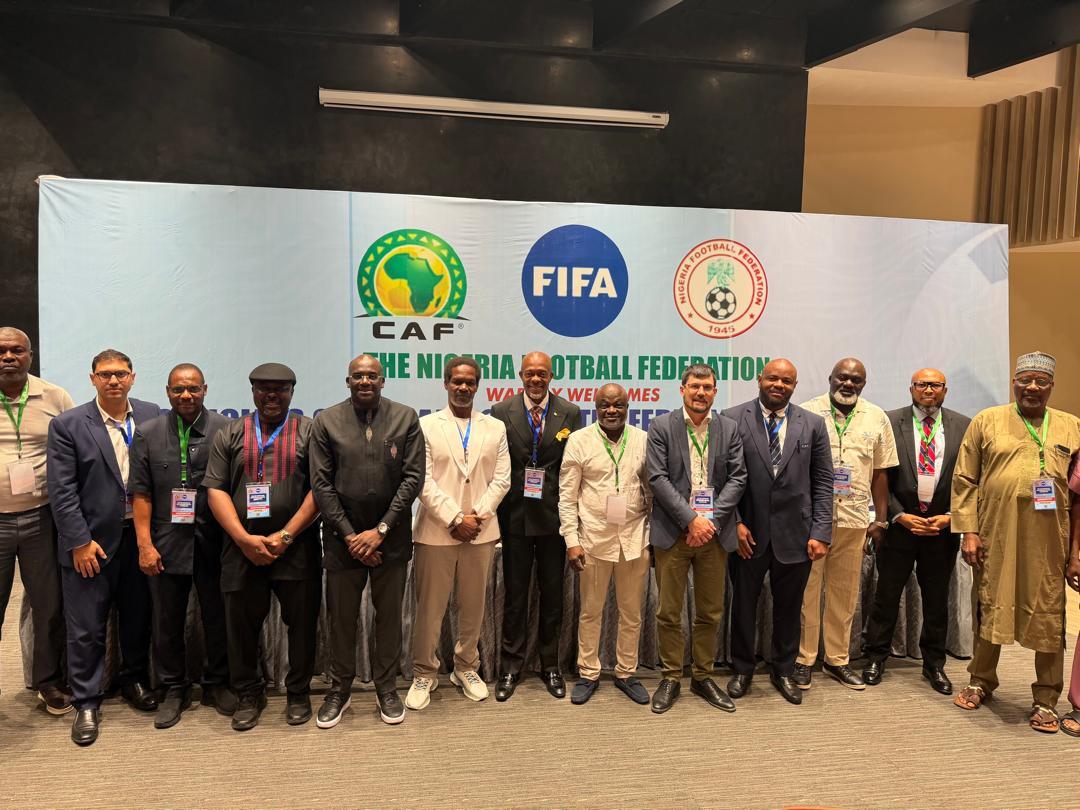
In September, a joint FIFA-CAF delegation visited Nigeria to consult football stakeholders and examine the circumstances surrounding the NFF leadership vacuum.
The mission held discussions with representatives of the NFF administration and Secretariat, state football associations, league bodies, electoral bodies, players, coaches, referees, clubs, former federation officials, sponsors, supporters and media representatives.
The breadth of the consultations was important because the crisis extends beyond the question of who occupies the federation’s leadership offices.
It also concerns the rules under which the NFF is governed, the confidence stakeholders have in its electoral process, the balance between internal autonomy and public-sector oversight, and the ability of the federation to make decisions in the interests of Nigerian football.
A credible assessment would need to consider the NFF’s statutes, the consequences of the resignations, the status of its existing congress and electoral structures, and the legal basis for any interim arrangement.
The delegation’s task was to gather information and perspectives. Its visit did not, by itself, constitute a final decision on the structure that should govern the federation.
Reports following the consultations suggested that a Normalisation Committee had gained support among some stakeholders. Other voices, particularly among state football association chairmen, argued that the existing congress should be allowed to lead the process within the federation’s established framework.
Those differing positions have made the choice of transitional arrangement one of the most sensitive issues in the reform debate.
OPTION ONE: A NORMALISATION COMMITTEE
A Normalisation Committee is a mechanism FIFA has used in certain football governance crises to temporarily administer a member association, restore institutional order and prepare the ground for fresh elections.
Such committees are generally established under FIFA’s authority and operate according to a defined mandate and timeframe. Their specific responsibilities depend on the circumstances of each case and the terms set out in the appointment.
In Nigeria’s case, proponents of normalisation have argued that a temporary committee could provide a structured route out of the present impasse.
Under proposals reported after the September consultations, a committee could be tasked with reviewing the NFF statutes, aligning governance arrangements with applicable FIFA requirements, establishing credible electoral structures and organising a fresh electoral process.
It could also oversee the federation’s day-to-day administration during the transition before handing over to a newly elected executive.
The attraction of this approach is that it offers the possibility of separating the reform process from the interests of individuals and groups seeking positions in the next NFF administration.
If properly constituted, transparent and time-limited, a Normalisation Committee could provide an opportunity to address disputes over the electoral framework before another election takes place.
It could also help establish a common understanding of the rules governing future elections, the responsibilities of the federation’s leadership and the representation of different football constituencies.
However, the creation of a committee would not automatically guarantee successful reform.
Its credibility would depend on who is appointed, how its mandate is defined, the extent of its independence, the transparency of its decisions and whether it operates within the applicable FIFA and NFF regulations.
A committee perceived as favouring particular interests could deepen existing divisions rather than resolve them.
There would also be legitimate questions about representation. Nigerian football includes state associations, leagues, clubs, players, coaches, referees, women’s football stakeholders, sponsors, supporters and the media. A transitional arrangement would need to understand these constituencies and ensure that reforms do not become an exercise conducted without meaningful consultation.
The timeframe would matter just as much. A temporary body should have clear objectives, measurable milestones and a credible handover plan. Normalisation must remain a means of restoring legitimate governance, not an indefinite substitute for elected leadership.
OPTION TWO: A CARETAKER ARRANGEMENT LED THROUGH EXISTING STRUCTURES
The alternative being discussed is an interim arrangement that places greater responsibility on the NFF’s existing congress and institutional structures.
Supporters of this approach argue that the federation already has established organs and regulations that should be used to resolve the leadership vacuum wherever possible.
Their position raises an important question: can the existing NFF Congress provide the legitimacy and institutional experience required to oversee reforms and organise fresh elections without a FIFA-appointed Normalisation Committee?
The argument in favour of an internal transition is straightforward. A federation’s own structures should not be discarded unnecessarily if they can lawfully and credibly manage the process.
An internal arrangement could preserve institutional continuity, limit disruption to the federation’s operations and give existing stakeholders a direct role in determining the way forward.
It could also avoid the perception that Nigerian football must be administered from outside whenever a major governance crisis occurs.
But the approach has its own challenges.
The resignations affected the executive leadership, while the planned elective congress was suspended pending the reform process. Any internal transition would therefore need to establish clearly which organs retain authority, how decisions are to be taken and what legal provisions govern the interim period.
It would also have to address the concerns that led to the present impasse. Simply restoring the old process without examining the rules, disputes and institutional weaknesses surrounding it would risk postponing rather than resolving the crisis.
A caretaker arrangement must not become a way of preserving the status quo under a different name.
For it to command confidence, its legal basis, membership, responsibilities and duration would need to be clearly established. Stakeholders would also need assurance that the transition would lead to a credible election rather than create another prolonged period of uncertainty.
Ultimately, the question is not whether an internal arrangement is inherently better or worse than normalisation. It is whether the proposed structure can operate lawfully, independently and effectively while preparing Nigerian football for a stable return to elected leadership.
NORMALISATION AND CARETAKER: WHAT IS THE REAL DIFFERENCE?
The terms are sometimes used interchangeably in public debate, but they should not be treated as identical without examining the actual mandate and authority of the proposed body.
A FIFA-appointed Normalisation Committee derives its authority from the international governing body’s decision and the terms of its appointment. Its mandate may include temporary administration, governance reforms and the organisation of fresh elections.
A caretaker arrangement, by contrast, can refer more broadly to a temporary administrative structure. Its authority depends on who establishes it, the applicable statutes and regulations, and the powers formally assigned to it.
A body called a caretaker committee would not necessarily be independent of the NFF’s existing structures. Nor would the label alone establish whether FIFA had approved its mandate.
Likewise, the existence of a Normalisation Committee would not automatically settle every question about representation, electoral fairness or accountability.
The decisive issues are the legal basis, the scope of authority, the reform objectives, the level of stakeholder confidence and the route back to elected leadership.
For this reason, the debate should move beyond labels. Nigerian football needs clarity on who will administer the federation, who will review the rules, who will supervise the electoral process and what safeguards will prevent a repetition of the present crisis.
THE ROLE OF THE NATIONAL SPORTS COMMISSION
The National Sports Commission, led by Chairman Shehu Dikko and Director-General Bukola Olopade, has been central to the federal government’s engagement with FIFA over the future of Nigerian football.
A Nigerian delegation led by Dikko met FIFA President Gianni Infantino and other officials at FIFA House in Zurich on September 1. The discussions focused on the NFF leadership crisis and proposals for reform.
The engagement demonstrated the government’s interest in finding a durable solution to the situation. It also placed the NSC at the centre of the discussions over the transition.
However, the relationship between public-sector sports administration and the autonomy of a national football association remains an important consideration.
FIFA’s governance framework requires member associations to manage their affairs independently and without undue third-party interference, subject to the applicable statutes and regulations.
That principle does not prevent a national government from engaging in legitimate sports policy, funding, infrastructure development or dialogue over governance concerns. It does mean that any arrangement for administering the NFF must be considered in light of the federation’s obligations as a FIFA member association.
The challenge for the NSC is therefore to pursue the reforms it considers necessary while ensuring that the final arrangement is compatible with FIFA’s requirements.
The most sustainable outcome would be one that gives Nigerian football a credible institutional framework, not merely a temporary administrative solution.
WHY THE OCTOBER 15 MEETING MATTERS
Nigeria’s inclusion on the FIFA Council agenda places the crisis before the governing body’s principal decision-making body between meetings of the FIFA Congress.
The agenda item is listed under Article 7, “Miscellaneous,” and the meeting is scheduled to begin at 11:00 a.m. Central European Time, with members participating by videoconference.
The listing is important because it confirms that the Nigerian situation is formally before the Council. It does not, however, establish what decision will be taken or whether a final announcement will be made during the meeting.
The Council could approve a Normalisation Committee, endorse another transitional arrangement, request further consultations or direct additional work before a final decision.
The possibility of a further process should not be confused with a failure to act. If FIFA determines that more legal or regulatory clarification is needed, it may consider that preferable to imposing an arrangement without adequately resolving the underlying issues.
At the same time, Nigerian football cannot remain indefinitely in a state of uncertainty. The longer the transition continues without a clear roadmap, the greater the risk of confusion over authority, reduced confidence among stakeholders and delays in implementing meaningful reforms.
The October 15 meeting is therefore significant not simply because a committee may or may not be approved, but because it offers an opportunity for FIFA to clarify the next stage of the process.
THE RISKS OF A POORLY MANAGED TRANSITION
Whatever arrangement FIFA ultimately chooses, the transition will be judged by its ability to resolve the crisis rather than simply administer it.
The first risk is a dispute over legitimacy. If important football constituencies believe that the process excludes them or favours particular groups, the new arrangement may inherit the same divisions that weakened the previous administration.
The second is uncertainty over the rules. Any review of the NFF statutes must be conducted transparently, with clarity about the provisions being examined and the procedures through which proposed amendments will be adopted.
The third is the possibility of an open-ended transition. A temporary arrangement without clear milestones can become a source of further controversy, especially if stakeholders cannot determine when elections will take place.
The fourth is the risk that reforms focus only on the executive leadership. Changes in personnel may be necessary, but they will not automatically improve financial accountability, administrative competence, competition management, grassroots development or the treatment of stakeholders.
Finally, the process must avoid reducing Nigerian football’s crisis to a contest between political and administrative interests. The ultimate purpose of reform should be to improve the institutions responsible for the game and create conditions in which football can develop sustainably.
WHAT SHOULD A CREDIBLE ROADMAP CONTAIN?
Regardless of whether FIFA chooses normalisation or another transitional structure, several principles should guide the process.
First, a clearly defined mandate. The transitional body should have written terms of reference explaining its powers, responsibilities and limits.
Second, a transparent review of the NFF statutes. Any proposed changes should be grounded in the applicable rules and communicated clearly to stakeholders.
Third, credible electoral arrangements. The process for selecting an Electoral Committee and Electoral Appeals Committee, where required, should be transparent and consistent with the relevant regulations.
Fourth, meaningful stakeholder consultation. State associations, clubs, leagues, players, coaches, referees, women’s football representatives, sponsors and other constituencies should have appropriate opportunities to contribute.
Fifth, financial and administrative accountability. Reform should address how the federation manages resources, makes decisions and reports on its activities.
Sixth, a realistic timeline. The transition should include clear milestones and a defined route towards fresh elections, subject to the applicable rules and any directions issued by FIFA.
Finally, a credible handover. The objective should be a functioning federation with an elected leadership and governance arrangements capable of withstanding future disputes.
These safeguards would help ensure that the process produces more than a temporary change in administration.
THE STAKEHOLDERS’ RESPONSIBILITY
FIFA’s decision will be central, but Nigerian football stakeholders will also have responsibilities in the transition.
The state associations and members of the NFF Congress will need to decide whether they can support a common reform framework, even where their preferred options differ.
The leagues, clubs, players, coaches and referees will need to engage constructively with the process and ensure that the reform agenda reflects the practical needs of the game.
The media will also have an important role in scrutinising decisions, distinguishing confirmed developments from speculation and asking whether promised reforms are being implemented.
Public debate is necessary, but it must be based on verifiable information. Claims about FIFA’s intentions, the proposed composition of a committee or the timing of fresh elections should not be presented as settled facts until the relevant authorities formally confirm them.
The challenge is to maintain pressure for reform without prejudging the outcome of FIFA’s deliberations.
BEYOND THE COMMITTEE QUESTION
The leadership crisis has exposed broader questions about the direction of Nigerian football.
The country has a substantial football following, a history of international success and a large pool of players, coaches and administrators. Yet those strengths must be supported by institutions capable of delivering consistent administration, credible competitions and long-term development.
A change in leadership structure will not, by itself, solve every problem.
The next phase of reform should address how the NFF sets priorities, manages its finances, develops domestic competitions, supports youth football, strengthens the women’s game and works with state associations and other stakeholders.
It should also establish clearer standards for accountability and performance, so that future administrations can be assessed against measurable objectives rather than promises alone.
A successful transition should leave the federation better equipped to manage disagreements through established rules and institutions. It should reduce the likelihood that future leadership disputes require another emergency intervention.
That is the standard against which any Normalisation Committee or caretaker arrangement should be judged.
SO, WILL IT BE NORMALISATION OR A CARETAKER COMMITTEE?
As the October 15 meeting approaches, normalisation remains a major possibility in the debate surrounding the NFF’s future, while some stakeholders continue to argue for an internal transition led through the federation’s existing congress and structures.
But the agenda listing alone does not confirm which option FIFA will choose.
The final decision will depend on the Council’s assessment of the facts, the applicable regulations, the consultations already conducted and the options presented to it.
If a Normalisation Committee is approved, attention will turn to its composition, mandate, timeframe and responsibility for organising fresh elections.
If FIFA supports another interim arrangement, the key questions will be whether its authority is clear, whether it can command stakeholder confidence and whether it can deliver the reforms required to restore stable elected leadership.
Either way, Nigerian football needs a process that is credible, transparent and time-bound.
The country cannot afford a transition that merely changes the names in charge while leaving the underlying governance problems unresolved. Nor should the desire for rapid elections outweigh the need to establish rules and institutions that can command confidence.
The real test of October 15 will not simply be whether FIFA chooses normalisation or a caretaker arrangement. It will be whether the decision creates a credible path towards a better-governed NFF and a durable return to elected leadership.
For Nigerian football, the priority must remain clear: resolve the immediate leadership vacuum, establish an accountable transition and ensure that the next administration emerges from a process capable of earning the confidence of the game’s stakeholders.


