
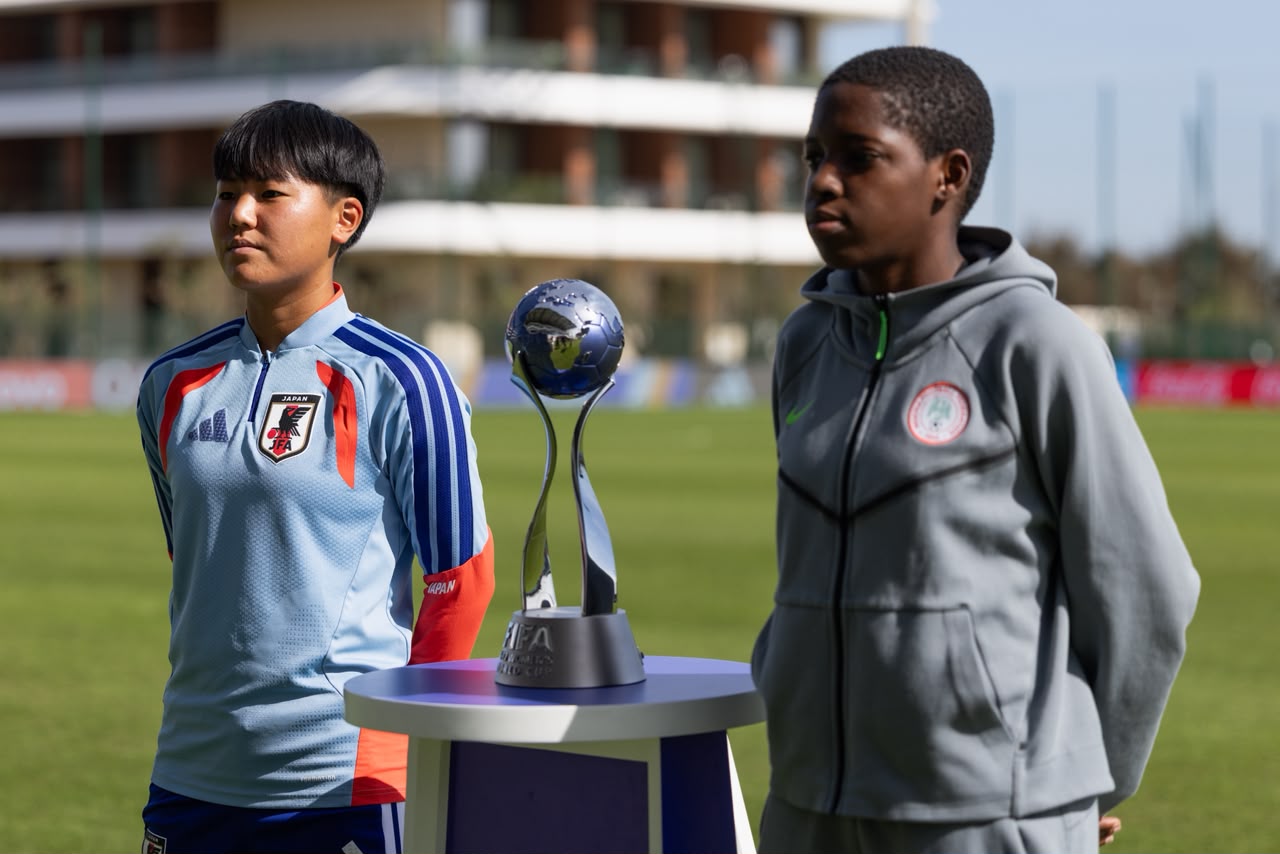
Nigeria vs Japan: U-17 Women’s World Cup Final Preview, Head-to-Head, Stars to Watch, Kick-Off and Probable Lineup
Samuel Ahmadu in Morocco
History beckons for Nigeria’s Flamingos when they face Japan in the final of the 2026 FIFA U-17 Women’s World Cup at the Mohammed VI Football Complex in Rabat on Saturday.
Nigeria will be appearing in the final of the competition for the first time, while Japan return to the championship match for the fourth time, with the Asian side seeking their second world title after their triumph in 2014.
For the Flamingos, however, Saturday’s encounter represents much more than a final. Victory would make Nigeria the first African nation to win the FIFA U-17 Women’s World Cup and would cap a remarkable campaign that began with an opening-day defeat to Poland.
Nigeria lost 2–1 to Poland in their first group match but have since won five consecutive games, eliminating Puerto Rico, DPR Korea, Mexico, Venezuela and Brazil on their route to the final. FIFA notes that Nigeria are seeking to become the first nation to lose its opening match at the tournament and go on to lift the trophy.
The Flamingos booked their place in the final with an emphatic 3–1 victory over Brazil in the semi-final. Queen Joseph opened the scoring before Awawu Bashiru came off the bench to make her first start of the tournament and scored twice, with Brazil’s Greise Kelly adding a late consolation.
Japan took a more dramatic route to the final, recovering from a 1–0 deficit against defending champions DPR Korea before forcing a 1–1 draw and eventually winning the penalty shootout 4–1. It was a result that sent Japan into their fourth final and ended DPR Korea’s attempt to retain the title.
Head-to-head
Saturday’s encounter will be the first meeting between Nigeria and Japan at the FIFA U-17 Women’s World Cup, adding another layer to an already historic final. There is therefore no previous tournament result between the two nations to provide either side with a psychological advantage.
The historical records of the two teams at this competition, however, are markedly different. Japan have participated in all ten editions and have reached the final four times, winning the 2014 edition. Nigeria, meanwhile, had never gone beyond third place before Morocco 2026, with their previous best finish coming in 2022.
Japan’s experience versus Nigeria’s momentum
Japan arrive with considerable tournament pedigree. Saturday will be their 50th match in the competition, while head coach Sadayoshi Shirai will take charge of his record 16th U-17 Women’s World Cup match.
The Japanese have also been difficult to break down. They have conceded only two goals throughout the tournament, against Kenya and DPR Korea, while scoring their way into another final. They are also one of only two nations — alongside New Zealand — to have appeared at every edition of the competition.
Nigeria, on the other hand, have displayed considerable attacking variety. The Flamingos have registered 113 attempts at goal in Morocco, the second-highest total in the tournament behind DPR Korea’s 186. They produced 35 attempts alone in their semi-final victory over Brazil.
Another strength of Busari’s team has been the distribution of goals. Eight different Nigerian players have scored at the tournament, with Oluwakemi Adegbuyi, Awawu Bashiru, Oluebube Umejiaku and Kanyinsola Yusuf each contributing twice. Mary Dunstan, Queen Joseph, Azeezat Oduntan and Precious Oscar have also found the net.
Stars to watch
Awawu Bashiru — Nigeria
Bashiru has suddenly become one of the biggest talking points surrounding the final. Before the semi-final against Brazil, she had played only 73 minutes in the tournament, all from the bench.
Given her opportunity to start against Brazil, the youngster responded with two goals and a Player of the Match performance. Her confidence, movement and ability to arrive in dangerous positions could again prove important against Japan’s disciplined defence.
Queen Joseph — Nigeria
Joseph has also emerged as one of Nigeria’s decisive attacking players. Her opening goal against Brazil demonstrated her ability to make the most of important moments, and her movement alongside Nigeria’s other forwards gives Busari several options in the final third.
Oluwakemi Adegbuyi — Nigeria
Adegbuyi has been one of Nigeria’s consistent attacking threats throughout the competition and has two goals to her name. Her pace and ability to stretch the opposition defence could be particularly important against Japan’s organised backline.
Fuki Ito — Japan
Ito has been one of Japan’s standout performers in Morocco. She was named Player of the Match in Japan’s opening 5–0 victory over Zambia and remains one of the players Nigeria will need to monitor closely.
Nanami Kurita — Japan
Kurita is another major threat for the Japanese. Her ability to contribute goals from midfield and attack makes her a player capable of changing the course of the final if Nigeria allow her space around the penalty area.
The tactical battle
The biggest question for Nigeria will be whether the Flamingos can maintain the attacking intensity that overwhelmed Brazil while preventing Japan from establishing control through their technical passing game.
Japan have shown an ability to patiently build attacks and combine in tight areas, while Nigeria have demonstrated greater directness and a willingness to attack with pace and numbers.
The midfield contest could therefore prove decisive. Nigeria will need to disrupt Japan’s rhythm without surrendering the attacking freedom that has produced five successive victories.
Busari also has the benefit of a squad that has demonstrated tactical adaptability throughout the tournament. Against Brazil, Nigeria produced 35 attempts and limited their opponents to only seven, according to FIFA’s tournament statistics.
The coaching battle
Nigeria head coach Hakeem Busari is preparing for the biggest match of his young international coaching career.
His Japanese counterpart, Sadayoshi Shirai, brings considerably more U-17 World Cup experience. Saturday will be his 16th match at the tournament, a record for a coach in the competition.
The contrast could make the tactical battle particularly intriguing: Busari’s rapidly developing Flamingos against a Japan side guided by a coach who has already experienced several matches at this level.
Probable line-ups
Both teams are expected to retain the core of the sides that carried them through the semi-finals, although the official starting line-ups will only be confirmed shortly before kick-off.
Nigeria Flamingos — probable 4-3-3:
Jane Ijirigho; Azeezat Oduntan, Ohunene Sunday, Esther Stephen, Kanyinsola Yusuf; Mary Dunstan, Favour Nkwocha, Awawu Bashiru; Queen Joseph, Oluwakemi Adegbuyi, Oluebube Umejiaku.
Japan — probable 4-4-2:
Riruha Wakatsuki; Anri Ito, Wara Shimizu, Honoka Yotsumoto, Himari Nishi; Fuki Ito, Mashiro Yamaji, Harana Matsushita, Keiko Kitajima; Kei Hanashiro, Nanami Kurita.
The projected Japanese squad is consistent with the players listed by the Japan Football Association for the final, while Nigeria’s projected XI follows the core group used by Busari in the knockout rounds.
Match officials
American referee Natalie Simon has been appointed to take charge of the final, with compatriots Katarzyna Wasiak and Kali Smith as assistant referees. Canadian officials Carly Shaw-McLaren and Melissa Snedden have been appointed as fourth official and reserve assistant referee respectively.
Kick-off and venue
The FIFA U-17 Women’s World Cup final between Japan and Nigeria will take place on Saturday, November 7, 2026, at the Mohammed VI Football Complex in Rabat, Morocco.
Kick-off is scheduled for 6:30 p.m. Morocco time (GMT) and 7:30 p.m. Nigerian time. FIFA moved the final from the originally scheduled venue to the Mohammed VI Football Complex, with the date and kick-off time unchanged.
What is at stake?
For Japan, it is another opportunity to add to an already impressive tournament history.
For Nigeria, it is a chance to complete the journey from an opening-match setback to world champions.
The Flamingos have already made history by becoming the first African nation to reach the final. Now they have one final obstacle standing between them and a landmark title.


