
SWAN to FIFA, CAF: Nigeria needs total football governance reset
The Sports Writers Association of Nigeria (SWAN) has called for a comprehensive reset of the country’s football governance architecture, insisting that the current leadership vacuum presents an opportunity to undertake fundamental institutional reforms rather than another temporary administrative arrangement.
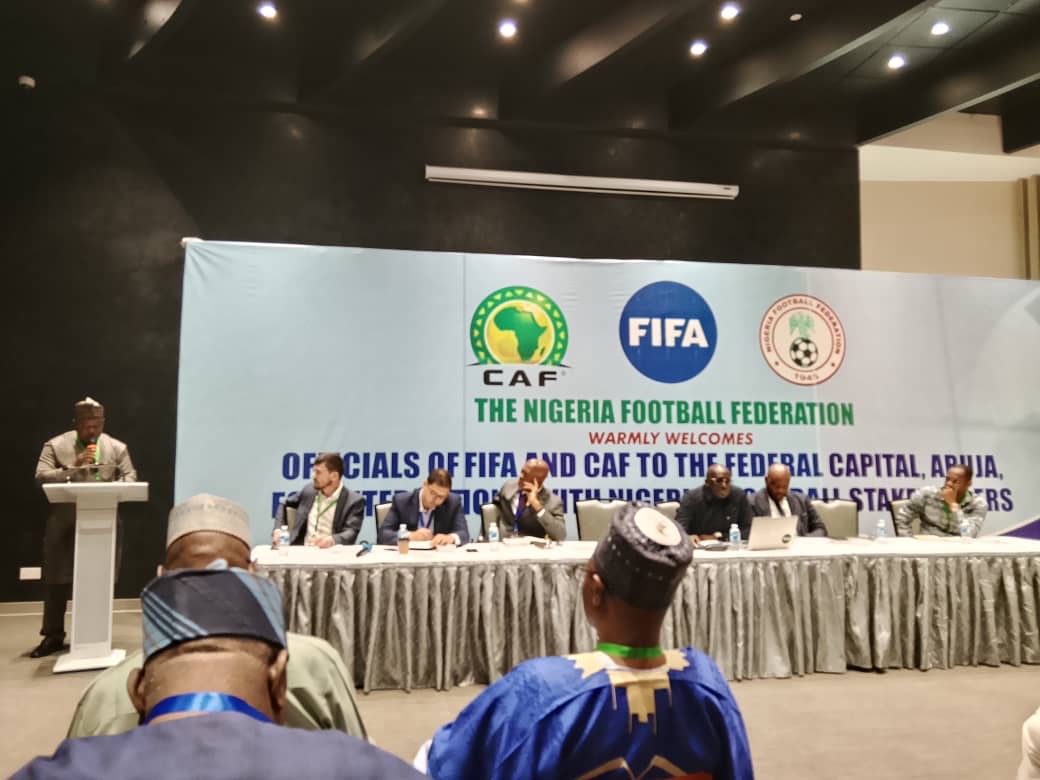
SWAN made the demand in an 18-page position paper presented by its President, Isaiah Benjamin, to the joint FIFA/CAF Fact-Finding Mission in Abuja following the resignation of Nigeria Football Federation (NFF) President Alhaji Ibrahim Gusau, General Secretary Dr Mohammed Sanusi and members of the federation’s Executive Committee.
Benjamin said the circumstances surrounding the current crisis should not simply lead to the restoration of another administration under the same structures, but should trigger a broader examination of how Nigerian football is governed from the grassroots to the national level.
“Nigeria does not require another cosmetic adjustment to its football administration. Nigeria requires a reset,” Benjamin declared.
He warned that rushing into another election without addressing structural weaknesses within the system could reproduce the governance disputes, leadership crises and transitional arrangements that have repeatedly affected Nigerian football.
“The current leadership vacuum provides an opportunity to address the fundamental question of what governance framework Nigerian football requires to become more democratic, accountable, commercially sustainable, development-oriented and internationally competitive,” Benjamin said.
A major component of the SWAN submission is the association’s demand for an end to what it described as the approximately 16-year exclusion of the sports media from formal football governance structures.
SWAN argued that sports journalists constitute an important part of the football ecosystem and possess institutional memory that can contribute to transparency, accountability, stakeholder engagement and the commercial visibility of the game.
“The sports media is not merely an external observer of football; it is a permanent part of the football ecosystem and an important vehicle for accountability, development and commercial visibility,” Benjamin said.
He called for structured participation of the sports media in stakeholder consultations and, where appropriate and permissible, transitional or advisory arrangements, alongside consideration of statutory recognition within an appropriate electoral and representation framework.
“Representation must be meaningful, transparent and institutionalised, rather than dependent on informal access or patronage,” he added.
The SWAN position paper also called for reforms beyond the NFF headquarters, arguing that sustainable football development must address the entire football pyramid.
Benjamin urged the strengthening of State Football Associations as genuine development institutions, while advocating improved governance, licensing and accountability frameworks for the Nigeria Premier Football League (NPFL), Nigeria Women Football League (NWFL), youth competitions and grassroots football.
“Meaningful reform must extend beyond the NFF headquarters in Abuja to the grassroots, State Football Associations, leagues and every major constituency that contributes to Nigerian football,” he noted.
SWAN’s proposed reform roadmap includes a comprehensive national governance audit and stakeholder mapping exercise, followed by a FIFA/CAF-supported national football dialogue involving the broad spectrum of football stakeholders.
The association is also seeking statutory and electoral reforms, a review of the composition and representation of the NFF Congress and Electoral College, appropriate transitional governance where necessary, and the establishment of a verified voters’ register.
Other proposals include grassroots-to-national elections, independent supervision of the NFF electoral process and binding post-election reforms designed to ensure that changes agreed during the reform process are implemented beyond the immediate transition.
Benjamin said the reform agenda is anchored on five core principles — Inclusion, Integrity, Representation, Accountability and Performance — which SWAN believes should guide the restructuring of Nigerian football administration.
He stressed that the objective should go beyond filling the current leadership vacuum or conducting another election, arguing that the country needs institutions capable of sustaining good governance regardless of who occupies individual offices.
“The objective should not simply be to restore an administrative structure and conduct another election, but to create a governance system capable of delivering stability, accountability, development and sustained international competitiveness,” Benjamin maintained.
The SWAN President further urged FIFA and CAF to consider the broader institutional circumstances behind Nigeria’s recurring football governance challenges as they assess submissions from stakeholders.
He said the present crisis, despite its serious implications, could become a turning point if stakeholders use the opportunity to address longstanding structural weaknesses rather than simply seek a quick return to the status quo.
“This crisis, while deeply concerning, also provides an opportunity for Nigerian football to undertake the structural reforms that have remained elusive for years and return the game to good governance,” Benjamin added.
SWAN maintained that any future reform process must be broad-based, transparent and inclusive, with the interests of players, coaches, referees, clubs, leagues, State Football Associations, supporters, sponsors, former administrators, the media and other recognised stakeholders taken into consideration.
The association consequently urged FIFA, CAF and Nigerian football stakeholders to treat the current transition as an opportunity to establish a more representative and accountable governance framework capable of supporting the long-term development of Nigerian football.


