
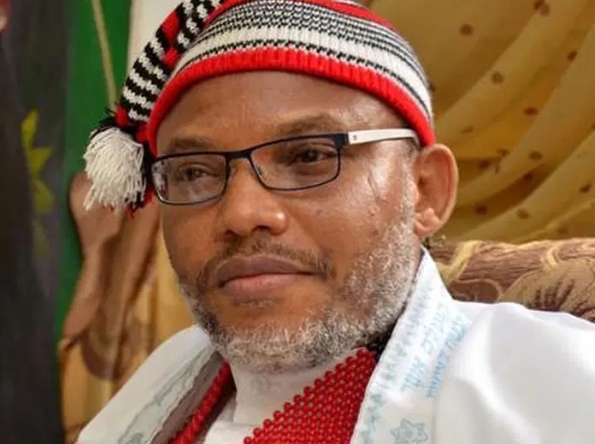
Court Declines to Halt Trial of IPOB Leader Nnamdi Kanu
ABUJA, Nigeria – The Federal High Court in Abuja on Friday refused to halt the ongoing trial of the detained leader of the Indigenous People of Biafra (IPOB), Mazi Nnamdi Kanu, dismissing a no-case submission he filed in a bid to terminate the proceedings.
In a ruling delivered by Justice James Omotosho, the court held that the prosecution had established a prima facie case against the defendant, warranting a response from him. Consequently, the court ordered Kanu to open his defence and scheduled the matter for continuation on October 8, 2025.
Kanu, through his legal team led by a former Attorney-General of the Federation and Minister of Justice, Chief Kanu Agabi, SAN, had asked the court to dismiss the seven-count charge filed against him by the Federal Government, arguing that the evidence presented did not link him to any offence.
The charges against the IPOB leader include terrorism and treasonable felony, stemming from his alleged role in inciting violence and the unlawful importation of a radio transmitter.
Defence: No Evidence, No Witnesses of Incitement
Arguing the no-case submission, Agabi contended that the Federal Government failed to produce any credible witness or material evidence establishing Kanu’s culpability. He noted that all five prosecution witnesses were operatives of the Department of State Services (DSS), none of whom testified to being incited or directly affected by Kanu's alleged actions.
Agabi further maintained that the alleged offensive broadcasts made by his client were either misconstrued or taken out of context, arguing that Kanu only called on people to defend themselves—an act he claimed was constitutionally protected.
“No citizen should be criminalized for calling for self-defence in the face of violence,” Agabi said, citing similar public statements by prominent Nigerians, including the Director-General of the DSS, Mr. Adeola Ajayi, and former Minister of Defence, Gen. Theophilus Danjuma (rtd).
He also criticised Kanu’s prolonged detention in solitary confinement—over six years—saying it violated international human rights standards that limit such detention to a maximum of 15 days.
Legal Challenge to IPOB’s Proscription
The defence also questioned the legality of the proscription of IPOB, asserting that it lacked presidential approval. “There can be no valid proscription without the express assent of the President. If the government claims otherwise, they should present the evidence,” Agabi argued.
Additionally, the defence challenged the court's jurisdiction over certain aspects of the case, including charges related to the alleged unlawful importation of transmission equipment.
Prosecution: Kanu Must Account for His Actions
Responding, the prosecution, led by Chief Adegboyega Awomolo, SAN, urged the court to reject the no-case submission. He insisted that the prosecution had presented sufficient video and audio evidence, in which Kanu not only identified himself as the leader of a proscribed group but also issued calls for violence and destruction.
Awomolo said the evidence showed that Kanu's actions were not merely rhetorical but contributed to violent acts, including the killing of at least 170 security personnel.
He further argued that the issue of IPOB’s proscription was already before the Supreme Court, and therefore outside the jurisdiction of the trial court.
Change of Trial Date
Justice Omotosho initially scheduled the continuation of the trial for October 10, but brought the hearing forward to October 8 after an affidavit of urgency was filed by Kanu's legal team, citing his deteriorating health in detention.
The court’s decision marks a significant development in the protracted legal battle involving the IPOB leader, who has been in detention since his extradition to Nigeria in 2021.


