
Seven matches, one kick-off time: The Heartbreak of Nigerian football's wasted potential
By Ruth Dave Williams
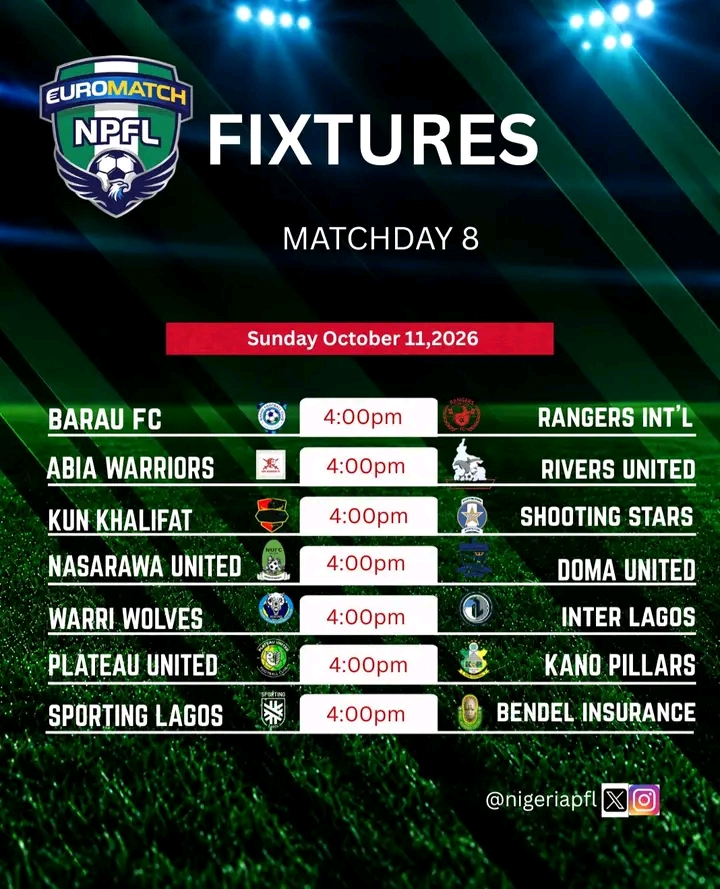
On Sunday, October 11, 2026, I looked at the Nigerian Premier Football League (NPFL) fixture list, and a familiar, deep sadness washed over me.
Seven matches. Seven chances to showcase the passion of our people. Seven moments to engage millions, inspire young kids, give sponsors their money's worth, and tell the rich, beautiful stories of our communities.
Yet, all seven matches were condemned to kick off at the exact same moment: 4:00 p.m.
Abia Warriors vs. Rivers United
Barau FC vs. Rangers International
Kun Khalifat vs. Shooting Stars
Nasarawa United vs. Doma United
Plateau United vs. Kano Pillars
Sporting Lagos vs. Bendel Insurance
Warri Wolves vs. Inter Lagos
Seven heartbeats of Nigerian football, forced to beat at once, and then vanish into silence.
I sat there asking myself: Are we truly trying to build a modern, professional industry, or are we just throwing 22 young men onto a pitch, blowing a whistle, and naively hoping commercial success will fall from the sky?
This breaks my heart. It breaks my heart because it is not a failure of talent. God knows we have the players. We have the history, the fierce rivalries, the culture, and a nation of fans whose love for the game runs deep in their veins. What we lack is the vision—the basic, commercial imagination—to turn that raw passion into a thriving enterprise.
And broadcast scheduling is the beating heart of that failure.
We Have the Passion. Why Are We Starving the Audience?
For years, I have bled for this cause, pleading that we stop treating football as mere afternoon recreation and start managing it as the multi-billion-naira industry it ought to be. Football creates jobs. It transforms destitute teenagers into global icons. It unites broken cities and drives local economies.
But an industry must honor its consumers.
In modern sports, your most sacred customer is the fan holding a screen, desperate to feel part of the narrative. Yet, our system acts as if the job ends the moment the ball rolls at kick-off.
What about the build-up? The pre-match tactical breakdowns? The emotional interviews with local coaches? The narrative arc that builds rivalries into national events? What about the post-match drama that keeps fans arguing in barbershops and on social media for days?
When you force seven games into a single broadcast window, you force the loyal fan into a tragic choice. Imagine a Nigerian football lover who bleeds for this league and wants to follow Rivers United, Rangers, Shooting Stars, Kano Pillars, and Sporting Lagos all in one afternoon. They can't. They are forced to pick one match, stare at fragmented text updates, or pray for poor-quality highlights hours later.
Imagine what could be if we cared enough to stagger these games.
Picture a Sunday where a match opens early in the afternoon, followed by a mid-day clash, leading into a prime-time evening blockbuster under stadium lights.
Picture dedicated studio coverage, crisp pre-match analysis, and seamless sponsor integrations. Broadcasters get narrative depth, advertisers reach engaged millions, and fans get a full day of pure, unfiltered Nigerian football.
Instead, we suffocate our own product in a single, overcrowded hour.
What Are We Selling to Sponsors... Promises or Products? This is where my frustration turns into genuine anguish. We constantly go cap-in-hand to banks, telecommunications giants, and corporate boardrooms, begging them to invest in Nigerian football. We preach to them about our millions of passionate fans and our rich footballing culture.
And they look us in the eye and ask: "Where are the numbers? Where is the coverage? How many eyes will see our logo this Sunday?"
And we stand there, empty-handed.
Sponsorship is not charity. It is a business exchange. Corporate Nigeria wants visibility, brand engagement, and measurable returns. When a corporate entity sponsors an NPFL club, how do we guarantee their brand reaches beyond the few thousand fans in the physical stadium? How do we take that brand into living rooms in Lagos, Kano, Port Harcourt, and the diaspora?
We cannot keep celebrating the number of matches completed while ignoring the millions of people locked out from watching them. Unseen football is wasted commercial value. Period.
We Cry About Poverty While Sitting on a Goldmine. It fills me with sorrow to hear our administrators constantly complain about a lack of funds, pleading for government bailouts or private hand-outs.
We are sitting on a goldmine, yet we choose to live in poverty because we refuse to package what we own.
A league with a clear, strategic broadcast design drives sponsorship, advertising, content licensing, digital subscriptions, and merchandise sales. It turns raw talent into household names and creates actual, tangible wealth.
Yes, the NPFL has taken commendable steps recently, partnerships for YouTube streaming and discussions around Friday night fixtures show a welcome spark of awareness. But streaming links alone will not save us if the core scheduling strategy remains stuck in the past.
The test isn't whether we have cameras at the stadium; the test is whether broadcasting strategy drives how we structure our entire league.
A Vision Born of Love, Not Bitterness
I write this not out of malice, but out of an overwhelming love for Nigerian football and a refusal to watch it languish.
I dream of an NPFL that knows its worth. I want to see our matches packaged with world-class production. I want to see our young people employed—not just as players, but as directors, camera operators, sports analysts, data scientists, and marketing strategists.
I want us to stop measuring a weekend by how many matches were played, and start measuring it by how many lives were reached and how much value was created.
Seven matches at 4:00 p.m. might seem like a small, technical detail to a casual observer. But to those of us who see what Nigerian football could be, it is a painful reminder of how far we are leaving our potential behind.
We cannot keep mourning the financial state of our clubs while refusing to fix the broken window through which the world is supposed to watch them.
The talent is ready. The fans are waiting. The story is waiting to be told. Our football doesn't just need our passion anymore. It desperately, urgently needs a plan.


